|
 |
|
|
Travel Destinations in Chile
|

|
The North
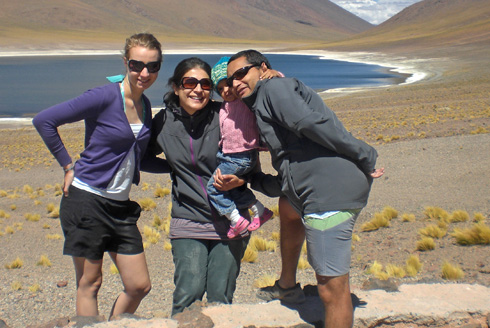
The North of Chile mesmerizes through its sheer size, an expansion of almost 2000 kilometres. It is defined by the multi-facetted Atacama Desert, one of the driest regions on earth, and the Altiplano, the Andean high plateau with its conical volcanoes and lagoons. The ports Arica, Iquique and Antofagasta or the mining towns of Calama and Copiapó make ideal starting points for excursions. The most popular travel destination in the North is San Pedro de Atacama – an oasis in the middle of the desert, surrounded by salt lakes full of flamingos, steaming geysers and a bizarre moon valley.
Central Region
This is the heart of Chile's political and cultural life – a third of Chile's population lives in and around Santiago alone. More climate zones than anywhere else in Chile come together here in the small space of the central region that has a distinct Mediterranean feel. The versatility of the Andes has no bounds: one can go hiking or skiing, or go surfing or kite surfing along the coast, taste the famous Chilean wines at one of the many vineyards, climb to the top of one of the 6000-m-high peaks or visit the twining houses of Chile's poet laureate, Pablo Neruda.
Lake District
This region is situated between the towns of Temuco and Puerto Montt and is renowned for its snow-capped, active volcanoes, its deep blue lakes and its silent forests. Even inexperienced mountaineers will be able to climb the volcano Villarrica near the tourist centre Pucón. Besides trips to the picturesque towns of Puerto Varas and Valdivia, the island Chiloé also beckons. It can only be reached by ferry and beguiles with green, rain-quenched hills, mythical legends and wood shingle architecture.
Patagonia
Chile's mythical south offers the traveller an awe-inspiring natural scenery: Along the Carretera Austral one can marvel at rain forests, fjords and glaciers, while further south the craggy peaks of the national park Torres del Paine captivate the viewer. Here one really feels as though one were at the end of the world, as only a mere 2 % of Chileans live in these wild stretches of the country. Southerly of the Strait of Magellan awaits the island group of Fireland: boat trips take seaworthy tourists to the Beagle Channel, to the storm-lashed Cape Horn and to the ice fjords of Antarctica.
Islands
3,800 kilometres off the Chilean coast, in the middle of the Pacific lies the solitary Easter Island, named Rapa Nui by its indigenous people, meaning 'navel of the world'. The most isolated inhabited island in the world is world-famous for its Moai stone figures that reach up to 6 metres in height. Divers get their money's worth, as do ‘beach bums’ and ‘culture vultures’. Farther south and “just” 700 kilometres off the continental coast the Juan-Fernández-Archipelago juts out of the sea. Its green main island, named 'Robinson Crusoe', is the site where the Scottish seaman was once abandoned, whose fate was to inspire Daniel Defoe's famous novel by the same name. The island is host to a unique fauna and flora as well as a legendary pirate treasure.
|
 |

Folk festival in the North


Spring in the Central Andes


Lake Llanquihue


Yelcho Glacier in Patagonia


Moai at Rano Raraku volcano
|
Top
of the page |
|
 |
|
 |
 |
 |
ContactChile
Gestiones Interculturales |
 |
 |
Huelén 219 piso 2
Providencia
Santiago de Chile
Ph./Fax: (56-2) 264 17 19
E-Mail: info@contactchile.cl
How to find our office
Business hours:
Mon - Fri 9 am to 5.30 pm
Sat 10 am to 1.30 pm
(Sat Housing only)
Local Time:
|
 |
 |
Quick inquiry |
 |
 |
|
 |
 |
Membership |
 |
 |
 |
 |
Certified by Fair Chile |
 |
 |
|
 |
 |
Current Exchange Rates
|
 |
 |
1 EUR = 615 CLP
1 USD = 485 CLP
|
 |
 |

|
 |
|
|